
Climate Transition Plans
Communications Services
Crafting a strong climate transition plan gives credibility to a company’s Net Zero ambitions. Investors and other stakeholders increasingly demand evidence that a company is taking steps to successfully achieve their ambitious climate targets.
Climate Transition Plans Fill a Critical Gap
Companies are facing increasing legal risks for abandoning or failing to meet their state Net Zero targets. Greater scrutiny relates to regulatory due diligence mechanisms such as the Corporate Sustainability Due Diligence Directive (CSDDD). In addition, communities and individuals are taking legal actions against governments and corporations that fail to uphold their climate commitments.
Meanwhile legal and climate risk authorities are clear about the need to transition. The UN ICJ announced its advisory opinion that states have an obligation to align with the 1.5C goal in the Paris Agreement. Global actuaries suggest that current climate policies would likely lead to a 50% loss in global GDP, including impacts such as mass mortality, displacement, and severe economic contraction from 2070 to 2090.
When climate policy and financial flows align, synergies help speed up the transition and create climate business opportunities, while avoiding costly risks. Climate transition plans support that aim.
Climate Transition Plan Resources
IFRS International Sustainability Standards Board S2 Standard
While CSRD no longer includes Climate Transition Plans as a requirement for mandatory reporting in the EU, many investors and stakeholders still request plans from companies.
Transition Plan Taskforce Framework
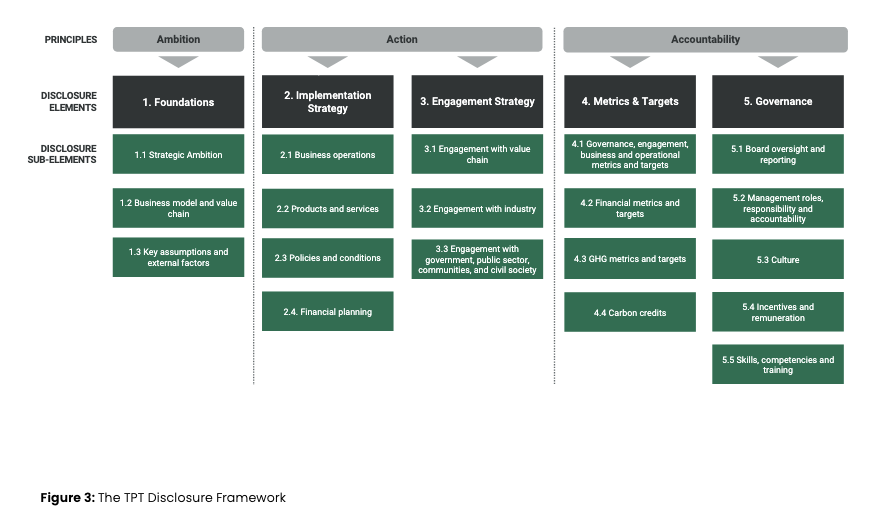
The TPT Disclsure Framework provides a useful breakdown of the main components of a climate transition plan including foundational elements, implementation strategy, engagement strategy, metrics & targets, and governance.
Credible Climate Transition Plans
Elements of credible climate transition plans include:
Science-based targets for Scopes 1, 2 and 3
Emissions reduction scenario analysis
Decarbonization levers (technology and strategic plans for reducing for Scope 1, 2 and 3 emissions)
Estimated percentage and absolute emissions for each decarbonization lever
Sector-specific abatement approaches
CO2 reduction metrics and financial metrics to achieve targets
Financial resourcing strategy
Transparency on uncertainties and assumptions in the plan
Strategic implementation of climate transition plan
Stakeholder engagement approaches
Governance and risk management approaches to achieve climate commitments
Leveling up your Climate Transition Plan
The Transition Pathway Initiative (TPI) provides helpful resources to help benchmark and assess CTP effectiveness through two lenses: management quality and carbon performance. In addition to the Transition Plan Taskforce framework, I use TPI's benchmarking guidelines in my approach to climate transition plan reporting.
Management Quality: This framework is a series of indicators that represent different levels of the strength of a company's CTP. According to TPI's State of the Corporate Transition 2025 Report, one of the least reported indicators is aligning CAPEX with climate goals.
Carbon Performance: Demonstrating emissions reductions against a Net Zero pathway to achieve stated targets requires an accurate emissions baseline and inventory, emissions data management, and year-over-year finance and project planning and implementation.
Partner with a Climate Transition Plan Specialist
Companies often assume their existing disclosures are enough to satisfy investor requests for climate transition plans, when more work to define a credible plan is advisable.
I have worked with companies preparing climate transition plans to support specialized investor requests. I have also supported climate transition plan reporting in the context of CSRD (aligned to the original 2023 ESRSs).
👉 Schedule a discovery call to learn more about my rates and process.